Sharing A Squash Court For Solo Drilling
A short squash article to improve your squash
Sharing a court when doing solo drills is a great way to reduce the cost of training. Here are some ideas of how to do it.
It’s that kind of thinking that shows those players don’t really understand the benefit of solo drilling. I suppose you could argue, that they do realize how valuable solo drilling is, but want to take advantage of having a partner. And a lot depends on how much time you have available for your squash.
One other aspect is the cost. Not everybody can afford to pay for a court just to do solo drills, and I full appreciate that point of view.
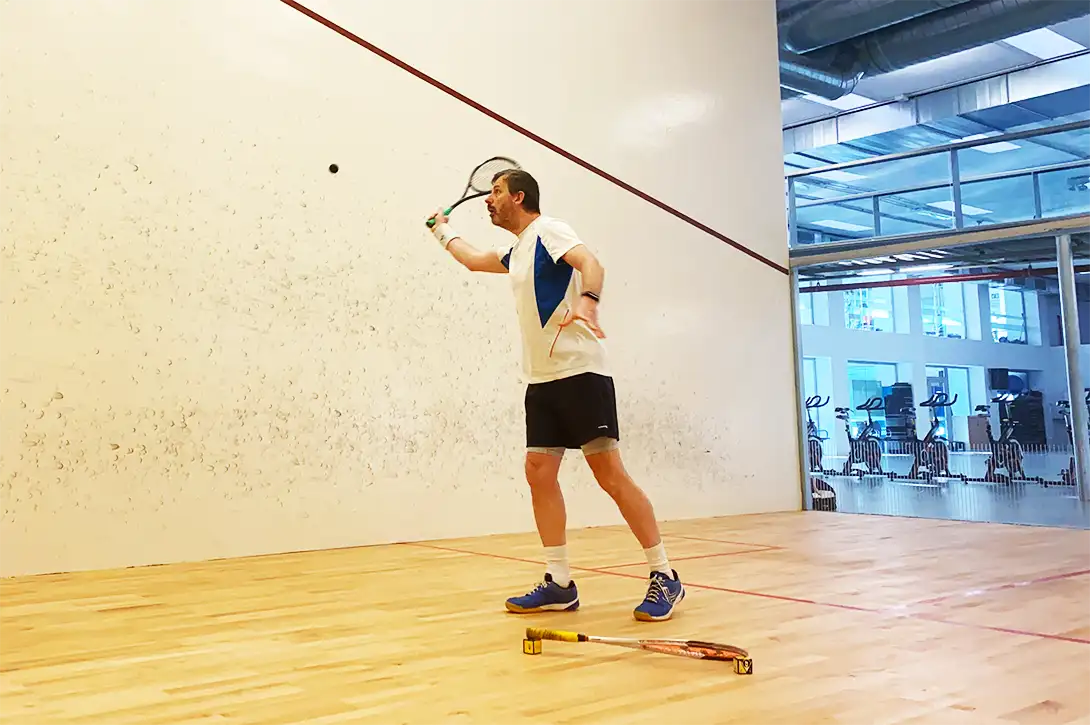
Curious about the racket on the floor?
That’s why you should schedule a training session once-per-week with a partner, where you spend the first 15 minutes doing solo drills (I’ll give you some ideas in a moment), the next 15 minutes doing pairs drills and the final 15 minutes playing conditioned games. if you court times are different, then adjust the times accordingly. This way, you will get the benefit of the three main types of training methods – just like a pro!
Nick Matthew has spent many hours doing solo drills.
Shared Court Solo Drills
When you think about it, unless you are running around, and there are some solo drills where you go from corner to corner!, most of the time you are either on one side of the court or in one half (front or back), so sharing a court really is quite easy and safe. Safe, that is, if you remember that there is another player around and if you shot goes to the other side of the court, you can’t just walk over and get it!
Many regular viewers of my videos (you do know I make videos, don’t you?) know that I promote the idea of performing solo drills is sets and and mega sets. A set is a combination of drills, mostly a power-based drill, followed by a skilled-based drill. This allows you to keep the ball hot, provide a fitness workout and keep things from getting boring. A mega set is 3 or 4 sets repeated together.
Sharing the court could allow you both players to do the same drill at the same time or be “opposite”. For example, both players could do the Side-To-Side drill for 50 shots, then they both move onto straight drives, again 50 shots – one player on the forehand, one of the backhand. Once completed, the do the side-to-side drill again, one in the front half of the court, one in the back. After those they do the straight drives again, but obviously on the opposite side they did early.
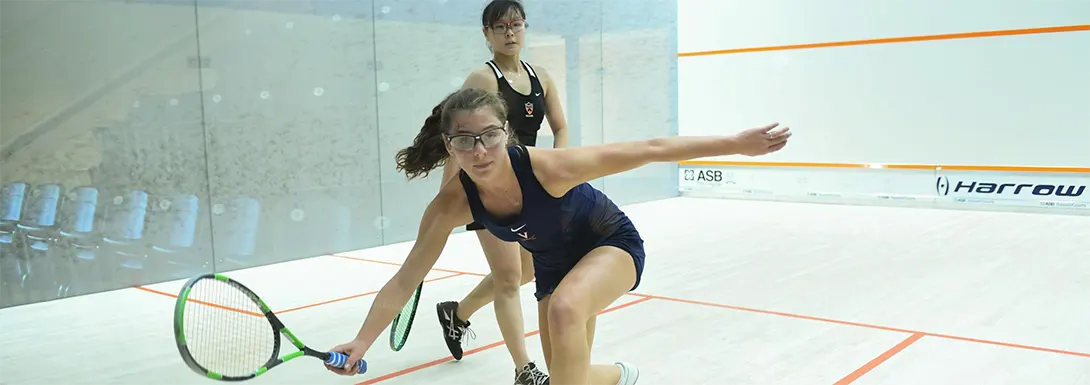
Getting down low to reach into the back corner.
Time To Step It Up!
With the simple addition of targets, A4 pieces of paper cut longways and given to each player, we can turn our relaxed shared solo drills into COMPETITIVE SHARED SOLO DRILL! (Sorry for shouting, but I get so excited). Place the targets in a place of your choosing – allow each player to choose the location for each drill – now do the 50 shots, but you get one point for each time you hit the target.
Depending of the drill and skill level of each player, you might need bigger targets, spare rackets can work well as there’s little doubt when they have been hit and they are bigger. if need be, you can even handicap the players by giving them bigger or smaller targets. The winner is the one with most points at the end of the 15 minutes.
Final Thoughts
Shared Solo Drilling can add that little bit of spice to a training session. Enough that you look forward to the next one. Give it a try.